

At the age of 2, my daughter found it irresistible to toss her shoes off at every puddle we came across so she could squish her toes in the mud. We lived in Massachusetts at the time, so this happened a lot. Needless to say, I learned to keep a towel with me. That was my introduction to the world of sensory processing needs and sensitivities. As humans, we have a need to physically explore our world in order to make sense of it and some of us are more sensitive to stimuli than others. The senses help us communicate and shape memory.
In my internship this semester, I’ve been working with an art therapy professor to build foundational modules in neuroscience and its connections in art therapy. I’ve enjoyed learning more about the subject and have grown as a designer. Recently, my subject matter expert brought up the interesting challenge of teaching a subject that’s highly tactile using a medium that isn’t.
So, I began to wonder, “How do I blend a sensory-rich field such as art therapy with the two dimensional one in the digital space?” It’s not something that can really be touched, so the art therapist’s familiar art forms like painting or molding clay are not easily available as practical applications of the learning material. Does this make an online learning platform less suited for a field such as art therapy?
Fortunately, the visual and audio elements common in learning design engage the senses that are most effective for retaining information and understanding complex processes. But are these elements enough for a rich learning experience? And are there ways that they could be enhanced or used to allow more of a multi-sensory experience? On the other side, what might be jarring or overwhelming to a sensitive learner, or deliver a message we don’t intend?
All of these questions and more are still being explored and from the research I’ve done on the subject, this is an evolving field in technology (i.e. how to integrate the senses). In their talk, “Designing for the five senses – storytelling in an oversaturated world,” Itamar Kubovy and Bruce Mau discuss a new medium they’re working on that will create a synesthesia, or blending, of the senses in an artistic experience. They discuss the importance of designing for time, emotion, connection and memory by integrating the senses and thinking of the user’s experience rather than our message.
The choices we make in design are crucial in the two-dimensional online space to create depth in our programs. Powerful images and sounds, storytelling and building for imagination are important concepts that I’ve come to understand better through this internship experience. Manipulatives such as drag & drop or flip card tools help create some sense of touch and movement, however limited. Ideally, all of these help support the learner’s sensory needs while also taking accessibility into consideration by providing choices in content delivery and medium.
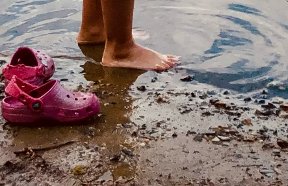
In my work, I’ve been aiming to use images that have a feeling of movement or texture where possible, such as this one that I used as the opening image in a module. I wanted something that would cause the learner to pause and wonder, “what is happening in this image?” and drive their curiosity to contemplate this balancing act.

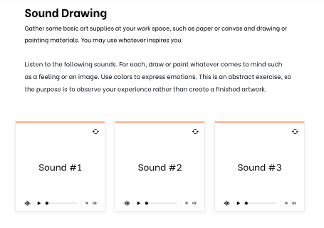
One of the exercises I put together integrates the digital space with the learner’s physical space. The learner gathers materials they have on hand and interacts with the lesson to create art. This experience is intended to link the content of the lesson with something tactile and interactive in order to build connection and evoke emotion.
Learning design is an exciting field and the challenge of how to bridge the gap between the digital world and our lived experience is just one of the many considerations I’m thinking about as a designer. I look forward to this opportunity to grow and explore ways to integrate the senses with online learning.
Member discussion